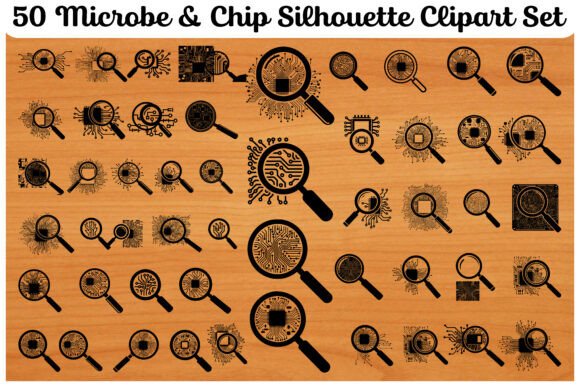
50 Microbe Chip Silhouette Clipart: Science-Meets-Tech Visuals That Just Work
If you’ve ever spent 20 minutes searching for “a clean, scalable icon of a microchip with a DNA strand or virus outline” — only to land on generic tech icons that feel sterile or overly cartoonish — you know the gap this bundle fills. 50 Microbe Chip Silhouette Clipart isn’t just another clipart pack. It’s a tightly curated set of visual tools built for people who need science credibility *and* design flexibility — without juggling five different file types or hiring a designer.
What You’re Actually Getting (No Guesswork)
Each of the 50 designs merges two worlds: the precision of microelectronics and the complexity of microbiology. Think circuit-board outlines shaped like bacteria, magnifying glasses zooming in on digital microbes, or data-flow diagrams embedded inside chip silhouettes. They’re not literal illustrations — they’re bold, high-contrast silhouettes, designed to scale cleanly from a 16-pixel favicon to a 48-inch trade-show banner.
And yes — all 50 come in six formats: SVG, EPS, AI, PNG, JPG, and PDF. That means if you’re building a cybersecurity training module in PowerPoint, you drop in the PNG. If you’re designing lab-branded merch in Illustrator, you open the AI file and recolor the entire chip in your brand palette in under a minute. If you’re prepping a conference handout for print, the EPS or PDF delivers crisp output every time — no pixelation, no font substitution surprises.
For Educators & Science Communicators
A high school biology teacher creating a slide deck on CRISPR and bioinformatics doesn’t need photorealistic renderings — she needs instantly legible, classroom-ready visuals that signal “this is about data *and* life.” One of these silhouettes — say, a microchip with double-helix contours — works as a section divider, a concept anchor, or even a worksheet icon. No licensing headaches, no attribution clutter. Same goes for university researchers drafting grant infographics: using a consistent, thematic visual language helps reviewers grasp interdisciplinary connections faster.
For Freelancers & Small Creative Teams
You’re pitching a rebrand for a startup developing AI-driven diagnostics. Their website feels clinical, their current icons are stocky and generic. With 50 Microbe Chip Silhouette Clipart, you swap out those flat “tech + health” clichés for something sharper: a vector of a neural network node fused with a stylized virus particle. It’s distinctive but not distracting — professional enough for investors, clear enough for non-technical users. And because every file is editable, you can tweak stroke weight, add subtle gradients, or align elements to match their UI system — all in one afternoon.
For Marketers Building Trust in Technical Niches
Cybersecurity firms, biotech SaaS platforms, and medtech startups often struggle to balance authority with approachability. A brochure full of dense text and server-rack photos won’t resonate. But a single, well-placed silhouette — like a shield-shaped chip containing binary code and a microbial outline — silently communicates “we protect digital *and* biological systems.” It’s subtle storytelling. Clients notice it in presentations. Journalists see it in press kits. It builds cohesion across email campaigns, landing pages, and LinkedIn banners — without repeating the same image five times.
For Hobbyists & Side-Project Creators
Maybe you run a science-themed sticker shop on Etsy. Or you design printable study guides for AP Biology students. Or you’re prototyping an educational card game about antibiotic resistance. In those cases, scalability and transparency matter more than fancy effects. The PNGs in this bundle have true alpha channels — no white halos around edges when pasted onto dark-mode apps or navy-blue posters. And because each design is isolated and uncluttered, they layer cleanly over textures, photos, or handwritten notes. No clipping masks needed.
What to Keep in Mind Before You Use Them
These aren’t animated GIFs or interactive components — they’re static, intentional silhouettes. That’s their strength *and* their boundary. If you need motion, 3D depth, or multistep illustrations (e.g., “how CRISPR edits DNA”), this isn’t the tool. But if you need clarity, consistency, and speed across dozens of touchpoints? It delivers.
Also worth noting: while all 50 designs share a cohesive style, they vary in complexity. Some are minimalist — a single-outline microchip with a tiny bacterium at its center. Others integrate layered concepts, like a circuit board forming the shape of a human cell nucleus. Skim the thumbnails first. Pick based on your project’s visual hierarchy: simpler silhouettes work better for small UI elements; denser ones hold up in large-format prints or presentation headers.
And remember — color customization is effortless, but contrast matters. These were designed for readability against light *and* dark backgrounds. Test your chosen fill color at actual size. A soft teal might look elegant on screen but vanish on a matte-finish poster. When in doubt, stick to your brand’s primary or secondary hues — the vectors respond predictably.
Why This Bundle Fits Where Other Clipart Doesn’t
Most tech clipart leans either “corporate sleek” (bluish gradients, floating orbs) or “school textbook basic” (clipart-style beakers and floppy disks). 50 Microbe Chip Silhouette Clipart sits in the middle — technically grounded, visually confident, and quietly intelligent. It doesn’t shout “I’m science!” or “I’m tech!” — it shows how those domains actually intersect in labs, startups, hospitals, and servers today.
That makes it unusually versatile. A public health nonprofit uses it in vaccine rollout infographics. A coding bootcamp drops one into their curriculum roadmap for a “Bioinformatics Track.” A freelance UX writer adds a subtle chip-microbe icon beside key terms in a technical glossary — helping readers anchor abstract ideas to tangible imagery.
In short: it’s not about having 50 images. It’s about having the right 50 — the kind you reach for again and again because they solve a problem before you finish framing the question.