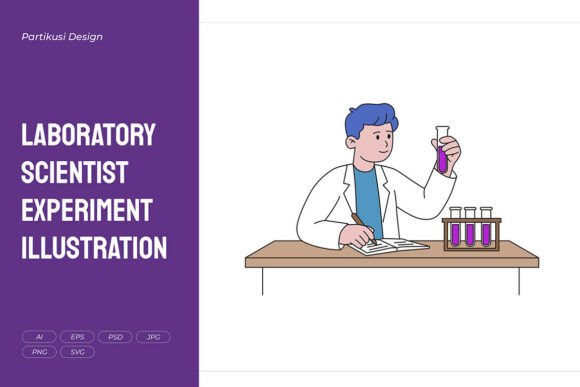
Laboratory Scientist Experiment Illustration
The Laboratory Scientist Experiment illustration is a professionally designed, flat vector image depicting a scientist engaged in routine laboratory work: analyzing liquid samples in test tubes, recording observations, and working methodically at a lab bench. It conveys scientific rigor, curiosity, and precision—without relying on realism or photorealistic detail. Instead, it uses soft colors, clean outlines, and balanced composition to deliver clarity and visual accessibility across digital and print formats.
What This Illustration Is Designed to Communicate
This illustration serves as a visual shorthand for scientific inquiry and evidence-based practice. It does not represent a specific experiment, institution, or protocol—but rather the broader concepts of research, analysis, documentation, and discovery. Its flat vector style avoids visual clutter while preserving legibility at small sizes, making it especially effective in contexts where conceptual accuracy matters more than technical specificity—such as educational slides, healthcare training modules, or biotech company websites.
Why Someone Might Consider This Illustration
Professionals and educators often need consistent, scalable visuals that align with scientific integrity and modern design standards. A generic stock photo may convey realism but lacks flexibility; a custom-drawn illustration offers control over tone, inclusivity, and branding. The Laboratory Scientist Experiment illustration meets this need by offering:
- Editable vector formats (AI, EPS, SVG) for resizing without quality loss;
- Layered PSD and PNG files for selective editing or background removal;
- A neutral, inclusive depiction of a scientist—supporting diverse representation in science communication;
- Soft color palettes that integrate smoothly into light- and dark-mode interfaces.
It is particularly relevant when the goal is to signal competence, process orientation, or methodological care—not to document a particular procedure.
Benefits and Practical Advantages
One key benefit is consistency across platforms. Because the file includes multiple formats, users can deploy the same asset in presentations (SVG), web banners (PNG), printed posters (EPS), or mobile app UIs (JPG). The well-organized layers allow non-designers to adjust colors or isolate elements—for example, changing lab coat color to match brand guidelines or removing text placeholders for use in multilingual materials.
Another advantage is time efficiency. Creating an original scientific illustration from scratch requires subject-matter input, iterative feedback, and graphic design expertise. Using a pre-vetted, scientifically plausible image like Laboratory Scientist Experiment reduces production time while maintaining credibility.
Tradeoffs and Considerations
Vector illustrations are not substitutes for technical diagrams or photorealistic reference material. If a project requires accurate depictions of specific equipment—such as a particular spectrophotometer model, microfluidic chip layout, or biosafety cabinet configuration—this illustration will not suffice. Its strength lies in abstraction and generalization, not precision engineering.
Similarly, while the scene shows standard lab activities, it does not indicate specialization. A pharmaceutical R&D team might need imagery emphasizing GMP compliance or sterile technique; a high school biology curriculum may prioritize simplicity and approachability. Users should assess whether the level of detail and implied context matches their audience’s expectations.
Also note: although the illustration is labeled “laboratory scientist,” it does not specify gender, ethnicity, or age. This supports broad applicability but may require supplemental customization if a project calls for intentional representation—such as highlighting underrepresented groups in STEM.
When This Illustration Is a Strong Fit
This asset works best in scenarios where clarity, scalability, and conceptual alignment outweigh the need for technical specificity. Examples include:
- Educational platforms introducing core scientific practices (e.g., hypothesis testing, data recording, controlled variables);
- Healthcare organizations explaining diagnostic workflows or clinical trial participation;
- Biotechnology startups building investor-facing decks that emphasize research capability without revealing proprietary methods;
- University departments designing recruitment materials that reflect collaborative, hands-on learning;
- Government or NGO reports illustrating public health surveillance or environmental monitoring programs.
In each case, the illustration functions as a reliable visual anchor—supporting written content without competing with it.
When Alternatives May Be Worth Considering
Consider other options if your use case demands:
- Real-world accuracy: Photographic assets or detailed technical illustrations better serve regulatory documentation, equipment manuals, or safety training where exact configurations matter.
- Narrative sequencing: A single static image cannot show cause-and-effect or procedural flow. In those cases, an illustrated step-by-step infographic or animated explainer may be more effective.
- Domain-specific symbolism: Fields like computational biology or AI-driven drug discovery may benefit from hybrid visuals—combining molecular structures with data visualizations—rather than traditional benchwork scenes.
- Localization needs: While the illustration itself is language-agnostic, accompanying text or UI elements may require culturally adapted metaphors or conventions not addressed by the base image.
Making a Practical Decision
To determine whether the Laboratory Scientist Experiment illustration aligns with your goals, ask three questions:
- What role does the image play? Is it decorative, explanatory, or functional? If it supports comprehension or sets tone—and isn’t expected to instruct—this illustration is likely appropriate.
- Who sees it, and how? Will it appear in a responsive web interface, a printed syllabus, or a slide deck projected in a large room? Vector scalability ensures adaptability across these contexts.
- What must remain unchanged? If your brand mandates strict color usage or requires integration with existing icon systems, verify that the layered files support those constraints before committing.
Finally, remember that visual assets work best when they complement—not replace—clear writing and sound pedagogy. An illustration like Laboratory Scientist Experiment gains value when paired with accurate descriptions, accessible language, and thoughtful information architecture.
Conclusion
The Laboratory Scientist Experiment illustration is a versatile, well-executed resource for communicators who need to represent scientific activity with clarity and professionalism. Its value emerges not from novelty, but from reliability: consistent formatting, intuitive structure, and conceptual fidelity. Whether used in education, healthcare, or industry, it supports understanding—provided users select it intentionally, customize it purposefully, and situate it within broader, audience-centered communication strategies.