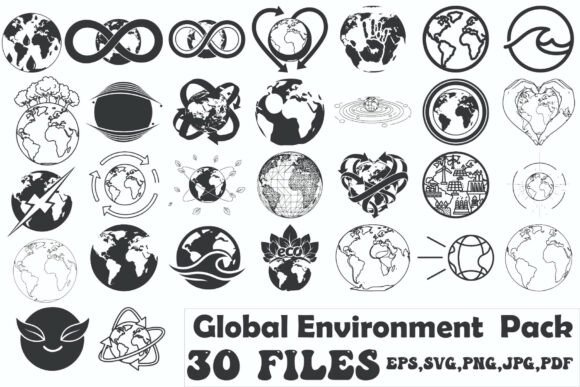
Global Environment Set
If you're designing for impact—whether it's a climate education handout, a nonprofit’s website refresh, or a startup’s sustainability report—you need symbols that speak clearly, instantly, and authentically. The Global Environment Set delivers exactly that: 30 carefully crafted, professionally designed icons focused exclusively on earth, ecology, sustainability, recycling, climate action, renewable energy, and nature conservation.
What sets this pack apart isn’t just quantity—it’s intentionality. Each icon was developed with visual clarity and communicative precision in mind. No vague abstractions. No overdesigned clutter. Just bold black silhouettes and clean outline styles against a crisp white background—optimized for legibility at any size and across any medium.
Why These Icons Work Where Others Fall Short
Many eco-themed icon libraries suffer from inconsistency—mixing flat design with skeuomorphism, varying stroke weights, or leaning too heavily on clichés (think overused leaf motifs or cartoonish wind turbines). The Global Environment Set avoids those pitfalls by committing to a unified visual language: strong negative space, balanced proportions, and deliberate simplification without sacrificing meaning.
Take the “solar panel” icon: it doesn’t try to render photovoltaic cells in detail. Instead, it uses three distinct horizontal bars within a rectangular frame—immediately recognizable, scalable down to 16px, and equally effective in a mobile app UI or a large-format poster. Or consider the “carbon footprint” icon—not a literal footprint filled with smoke, but a stylized shoe outline with subtle CO₂ molecules orbiting it. It conveys the concept without visual noise.
This consistency translates directly into efficiency. You’re not spending time tweaking stroke alignment or adjusting contrast across icons. You open the file and start building—whether you’re a designer finalizing a pitch deck or a teacher assembling classroom materials.
Real-World Uses Across Roles and Contexts
For educators and nonprofits: Use the “biodiversity,” “water cycle,” or “forest restoration” icons in lesson plans, workshop handouts, or community campaign posters. Their high contrast ensures readability when printed on recycled paper or projected in dimly lit classrooms.
For marketers and content creators: Embed the “zero-waste lifestyle,” “electric vehicle,” or “compost bin” icons into blog graphics, social media carousels, or email headers. Because they’re available in SVG and PNG formats—including transparent backgrounds—they integrate seamlessly into Canva, Figma, or WordPress without extra editing.
For developers and UX designers: Drop the SVG files directly into web projects. They scale infinitely, load fast, and require no external dependencies. Pair the “wind turbine” icon with an animated counter showing real-time energy savings on a dashboard—and it feels both professional and purposeful.
For small business owners and freelancers: Build cohesive brand assets quickly. Use the “eco-certified” or “green supply chain” icons in service packages, proposal decks, or client presentations. Consistent visuals reinforce credibility—especially when your audience includes sustainability officers or ESG-focused buyers.
Formats That Fit Your Workflow—Not the Other Way Around
The Global Environment Set ships with five core formats: EPS, SVG, PNG, JPG, and PDF. That’s not overkill—it’s flexibility grounded in practical need.
- SVG is your go-to for responsive websites, interactive dashboards, or animations. It’s lightweight, editable in code, and accessible with proper ARIA labeling.
- EPS ensures print-ready fidelity for brochures, signage, or branded merchandise—even when scaled to billboard size.
- PNG (with transparency) works flawlessly in slide decks, social posts, and mockups where background context matters.
- JPG provides compatibility with legacy systems or platforms that don’t support vector imports.
- PDF serves as both a preview file and a ready-to-print reference sheet—ideal for team briefings or stakeholder reviews.
No conversions. No guesswork. Just open, select, and apply.
What to Keep in Mind Before You Use Them
While the Global Environment Set excels in clarity and versatility, thoughtful implementation still matters. Here are a few grounded considerations:
First, context shapes meaning. An icon like “recycling loop” reads universally—but paired with ambiguous text like “Our Process,” it may confuse rather than clarify. Always pair icons with concise, action-oriented labels—especially in multilingual or cross-cultural settings.
Second, accessibility isn’t optional. When using SVGs on websites, include descriptive title and desc elements—or use ARIA attributes if embedding inline. For print, ensure sufficient contrast between icon and background (the black-on-white base meets WCAG AA standards, but avoid placing them over busy textures or low-contrast photos).
Third, brand alignment matters. These icons follow a neutral, authoritative aesthetic—not playful, not corporate-glossy, not overly technical. If your brand voice leans whimsical or ultra-minimalist, test how they sit alongside your existing typography and color system before full rollout.
A Practical Starting Point
Don’t try to use all 30 icons at once. Start small. Pick three that align with your current project’s core message—say, “climate resilience,” “circular economy,” and “clean water access.” Use them consistently across one campaign or presentation. Notice how much faster your audience grasps the narrative. Then expand.
You’ll also find value in the set’s intentional gaps. There’s no “green dollar” or “eco-friendly product” icon—because those concepts are better served by custom illustration or photography. This restraint keeps the collection focused, credible, and useful—not bloated with filler.
In a landscape where environmental messaging risks feeling generic or overwhelming, the Global Environment Set gives you grounded, human-centered tools. Not just decoration. Not just symbolism. But functional, reusable, respectful visual language—for people who care about what they make, and why.