Global Network Silhouettes
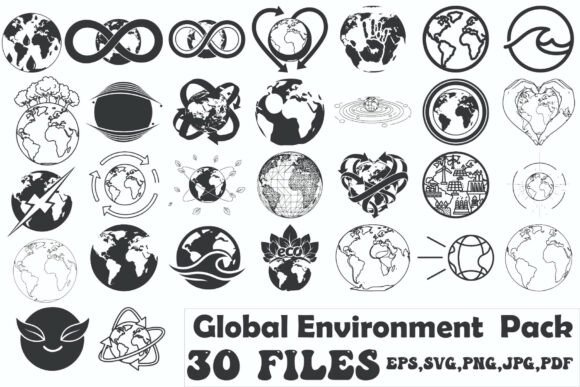
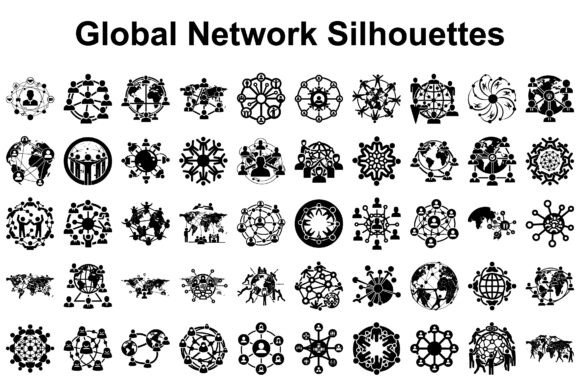
Imagine a visual language that doesn’t shout—but connects. That’s the quiet power of Global Network Silhouettes: a curated bundle of 50 hand-crafted vector illustrations that map out digital interdependence without a single word. These aren’t generic wireframe graphics or overused globe-and-circuit clichés. Each silhouette is a distilled moment of connection—data flowing across continents, nodes pulsing in sync, fiber-optic veins tracing invisible pathways between cities, devices, and people. The style balances precision and poetry: clean lines, intentional negative space, balanced weight distribution, and subtle asymmetry that suggests motion rather than stasis. There’s warmth in the geometry—no cold sterility here. Think of them as visual metaphors made tangible: not just “tech,” but trust, collaboration, scalability, and shared infrastructure.
Where These Silhouettes Earn Their Keep
Designers reach for Global Network Silhouettes when they need meaning *and* flexibility—not decoration. In presentations for SaaS startups or sustainability reports, a single silhouette can anchor a slide about cross-border data compliance or real-time supply chain visibility. They work just as well on a conference poster explaining API integrations as they do on the back of a T-shirt for a dev meetup—because their visual clarity holds up at any scale, from thumbnail to billboard.
For UI/UX designers, these assets slot cleanly into dashboard icons, empty-state illustrations, or onboarding flows where abstract concepts like “syncing,” “cloud backup,” or “multi-region deployment” need intuitive visual shorthand. Marketers use them in social media carousels comparing legacy vs. modern infrastructures—or in email headers that signal reliability without resorting to stock photos of handshakes or glowing globes. Publishers embed them in educational infographics about internet governance or IoT ecosystems. Even crafters repurpose them for laser-cut wall art or embroidered patches, thanks to the crisp SVG and EPS files included.
What makes them especially useful across print and digital? Consistency without rigidity. Unlike photographic assets that age quickly or require heavy retouching, these silhouettes retain relevance because they avoid dated UI trends or fleeting tech aesthetics. They’re built to support your message—not distract from it.
More Than Decoration: How Visual Language Shapes Perception
Visual hierarchy isn’t just about size or color—it’s about cognitive load. A cluttered network diagram overwhelms; a simplified silhouette invites focus. When you use Global Network Silhouettes, you’re subtly guiding attention toward relationships—not components. That shift matters. In branding, it positions your company as systems-thinkers, not just tool-sellers. In editorial design, it signals authority on complex topics without condescension. And in packaging or product documentation, it reinforces trust: if your visuals treat connectivity with intention, audiences assume your technology does too.
Recognition builds over time—not through repetition alone, but through coherence. Using the same set of silhouettes across your website, investor deck, and trade show banners creates an unspoken visual grammar. It’s not logo-level branding, but it’s part of what makes your materials feel *of a piece*. That cohesion reads as professionalism—even when your team is small or your budget lean.
Choosing—and Using—Them Well
Start by asking: *What’s the core idea I’m illustrating?* Not “technology,” but “real-time collaboration across three time zones.” Not “security,” but “end-to-end encryption between device and server.” Match the silhouette to that specific nuance—not just the broad category. One design might emphasize layered architecture (ideal for cloud stack diagrams); another focuses on radial symmetry (perfect for illustrating decentralized consensus models).
Test pairings early. Drop a silhouette beside your existing typeface. Does it compete—or complement? Sans serif fonts like Inter or IBM Plex often harmonize naturally, letting the silhouettes breathe. Avoid overly decorative scripts or tight serifs unless you’re intentionally creating contrast for editorial impact. Also check legibility in context: zoom out to 25% view. If the connections blur or nodes merge, scale up or choose a version with slightly bolder strokes (many in the bundle include subtle weight variations).
All 50 designs come in SVG (scalable, editable), PNG (transparent background, ready for web), JPG (lightweight for email or CMS uploads), and EPS (for legacy print workflows). No raster-only surprises. You’re covered whether you’re building Figma prototypes, prepping a Canva social post, or handing files to a commercial printer for conference signage.
Licensing That Fits Real Workflows
This is a commercial license—no hidden restrictions, no per-seat fees, no attribution required. You can use these silhouettes in client projects, sell them embedded in templates (like Notion dashboards or PowerPoint kits), or feature them on merchandise you produce and distribute. What you *can’t* do is resell the raw files standalone or claim authorship. But that’s standard, ethical practice—not a limitation.
Small business owners and solo creators especially appreciate this clarity. You’re not licensing “access”—you’re acquiring working assets. Need to tweak stroke width in Illustrator? Go ahead. Want to recolor one for a brand palette? Done. Translate a concept into a physical product? Fully supported.
If you’ve ever spent hours searching for a single usable network graphic—only to find it’s low-res, watermarked, or locked behind a subscription—you’ll recognize the value here. Global Network Silhouettes removes friction so you can focus on solving the actual problem: how to make global complexity feel clear, human, and actionable.