Global Business Strategy Analysis: Turning Data, Maps, and Teams into Actionable Growth
Today’s most resilient companies don’t just expand overseas—they orchestrate international growth. That orchestration starts with Global Business Strategy Analysis: a disciplined, evidence-based process that transforms raw market signals, cultural insights, competitive intelligence, and operational realities into coherent, executable plans. It’s not about guessing where to open an office or launch a product. It’s about knowing—before the first contract is signed—where demand is scalable, where regulation aligns with capability, and where local partnerships amplify reach instead of complicating it.
What Global Business Strategy Analysis Really Does (Beyond the Buzzwords)
At its core, Global Business Strategy Analysis bridges three critical gaps:
- The data-to-decision gap: Collecting GDP trends, import tariffs, social media sentiment, or logistics lead times means little unless synthesized into clear trade-offs—e.g., “Entering Brazil via e-commerce partners reduces time-to-market by 4 months but caps margin at 18%.”
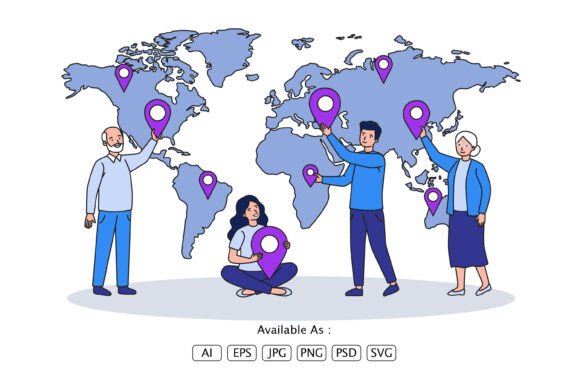
- The map-to-mind gap: A world map dotted with pins isn’t just decoration—it’s a visual anchor for cross-functional alignment. When marketing sees the same geographic clusters as supply chain and legal, assumptions surface faster, misalignment shrinks, and resource allocation becomes intentional—not reactive.
- The team-to-timing gap: Global expansion stalls when analysts, executives, and regional leads operate on different timelines and definitions. Global Business Strategy Analysis creates shared rhythm: quarterly market health checks, biannual regulatory horizon scans, real-time competitive response protocols.
This isn’t theoretical. Consider a European SaaS startup evaluating APAC entry. Without structured Global Business Strategy Analysis, they might default to Singapore—logistically convenient, English-speaking, business-friendly. But deeper analysis reveals Indonesia’s 75M+ digital-first SMEs, rising mobile payment adoption, and under-served verticals in construction software. That insight shifts the strategy from “launch in Singapore first” to “co-develop with Jakarta-based integrators while using Singapore as a compliance hub.” The difference? Speed, relevance, and long-term stickiness.
Why Visual Clarity Matters—More Than You Think
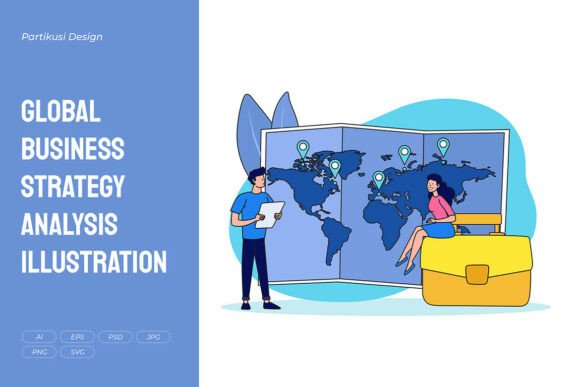
Enter the illustration: professionals collaborating around a large, annotated world map, laptops open, location pins precisely placed. This isn’t just aesthetic—it reflects how Global Business Strategy Analysis works in practice. Flat design, clean lines, and balanced proportions aren’t stylistic choices alone. They signal clarity, scalability, and intentionality—qualities essential to the analysis itself.
Think about how this visual functions across real workflows:
- In pitch decks: Investors scan slides in seconds. A single, high-fidelity image conveys global readiness, analytical rigor, and collaborative execution better than three bullet points.
- In internal dashboards: When teams review quarterly performance, overlaying sales data onto the same world map used in strategy sessions reinforces continuity. The visual becomes a living reference—not a one-off graphic.
- In training modules: New hires grasp the interplay between market research, legal constraints, and customer behavior faster when anchored to a consistent, intuitive visual language.
The file formats matter too—AI, EPS, SVG for infinite resizing without pixelation; PSD layers for quick client-specific edits (swap colors, add logos, highlight priority regions); transparent PNGs for seamless integration into web banners or Slack announcements. This versatility ensures the illustration doesn’t sit in a folder—it moves with the strategy, adapting as priorities shift.
Who Uses Global Business Strategy Analysis—and Where It Hits Home
It’s easy to assume this is only for Fortune 500 multinationals. In reality, the discipline scales down—and up—with precision.
A U.S.-based specialty coffee roaster evaluating export to South Korea uses Global Business Strategy Analysis to weigh: customs classification codes for roasted beans, Korean consumer preferences for cold brew vs. pour-over packaging, influencer engagement patterns on Naver Blog, and air freight volatility versus sea container costs. Each variable feeds a weighted decision matrix—not gut instinct.
A Nigerian fintech building cross-border remittance tools applies the same framework—but focuses on KYC reciprocity between Nigeria and Ghana, mobile money interoperability standards, and central bank sandbox requirements. Here, “global” means two neighboring countries with deeply asymmetric regulatory maturity. The analysis adjusts accordingly.
Consultancies embed Global Business Strategy Analysis into discovery workshops—not as a standalone report, but as a co-creation process. Clients annotate the world map live: “This pin is where our distributor failed last year—let’s diagnose why.” That immediacy builds ownership and surfaces blind spots no desk research could uncover.
Practical Signals of Strong Global Business Strategy Analysis
Not all analyses deliver equal value. Look for these markers:
- Local context baked in—not bolted on. Does the analysis cite specific labor laws in Vietnam’s Da Nang province—or just “Vietnam’s labor regulations”? Does it reference actual consumer price indices for fresh produce in São Paulo markets—or rely on national averages?
- Dynamic thresholds—not static targets. Instead of “enter 5 new markets by 2026,” strong analysis defines triggers: “Launch in Poland if B2B SaaS adoption grows >12% YoY AND local cloud infrastructure uptime exceeds 99.5% for six consecutive months.”
- Exit criteria—not just entry logic. Smart strategies include pre-defined indicators for pausing, pivoting, or withdrawing: e.g., “If local partner churn exceeds 30% within 18 months, activate contingency plan with Tier-2 distributors.”
- Visual traceability. Can you follow the thread from raw data source → analytical model → map annotation → executive recommendation? The illustration serves as that connective tissue—making the logic visible, debatable, and actionable.
Getting Started—Without Over-Engineering
You don’t need a 20-person global strategy team to begin. Start small, but start with structure:
- Map your current footprint first. Drop accurate pins—not just “Europe” but “Berlin (HQ), Lisbon (Dev), Warsaw (Support).” This reveals hidden dependencies and capacity limits.
- Define one strategic question per quarter. “Which three Southeast Asian markets offer the strongest alignment between our compliance capabilities and unmet SMB pain points?” Keep it narrow. Answer it thoroughly.
- Use the illustration as a working canvas. Import the SVG into Figma or PowerPoint. Add live data layers. Annotate with color-coded risk scores. Let it evolve.
- Rotate ownership. Have finance lead the tariff analysis one cycle, marketing own the social listening deep dive the next. Cross-pollination prevents silos before they form.
Global Business Strategy Analysis isn’t about eliminating uncertainty—it’s about reducing ambiguity. It turns overwhelming complexity into bounded, testable hypotheses. And when paired with a clean, professional, infinitely adaptable visual like the world map illustration, it becomes more than analysis. It becomes a shared language—one that aligns engineers in Bangalore, marketers in Berlin, and executives in Boston around the same north star: sustainable, intelligent, human-centered global growth.